
In the summer of 2024, Victoria Davies went to what should have been a routine appointment. She was 20-weeks pregnant, and excited to see her baby on the ultrasound machine at Concord Hospital. But when doctors found an echogenic focus on her unborn son’s heart, they referred her to maternal fetal medicine at Dartmouth Hitchcock Clinics in Bedford, N.H.
At the clinic, doctors told Davies the echogenic focus likely meant that her son had both Down syndrome and duodenal atresia, a condition characterized by the disconnection between the stomach and intestines.
“You have this picture in your mind of what your child is going to be,” Victoria says, her voice catching at the memory. “My husband Christopher is a Marine, my stepson is a Marine. So I thought, well, ‘[My son] Dean’s going to be a Marine.’ Then someone gives you a diagnosis. It was grief. Pure grief.”
‘The Best of the Worst’
Still, Victoria and Christopher tried to remain hopeful.
On October 9, 2024, in a surgical suite filled with 20 medical professionals, Dean was born weighing eight pounds, nine ounces. Victoria barely had time for chest-to-chest contact before the neonatology team swept him away. Her newborn son couldn’t swallow fluids and needed a Repogle tube to drain them from his esophagus. He had low muscle tone and needed oxygen. Victoria, exhausted from labor, recalls her newborn son being connected to “all these wires.”
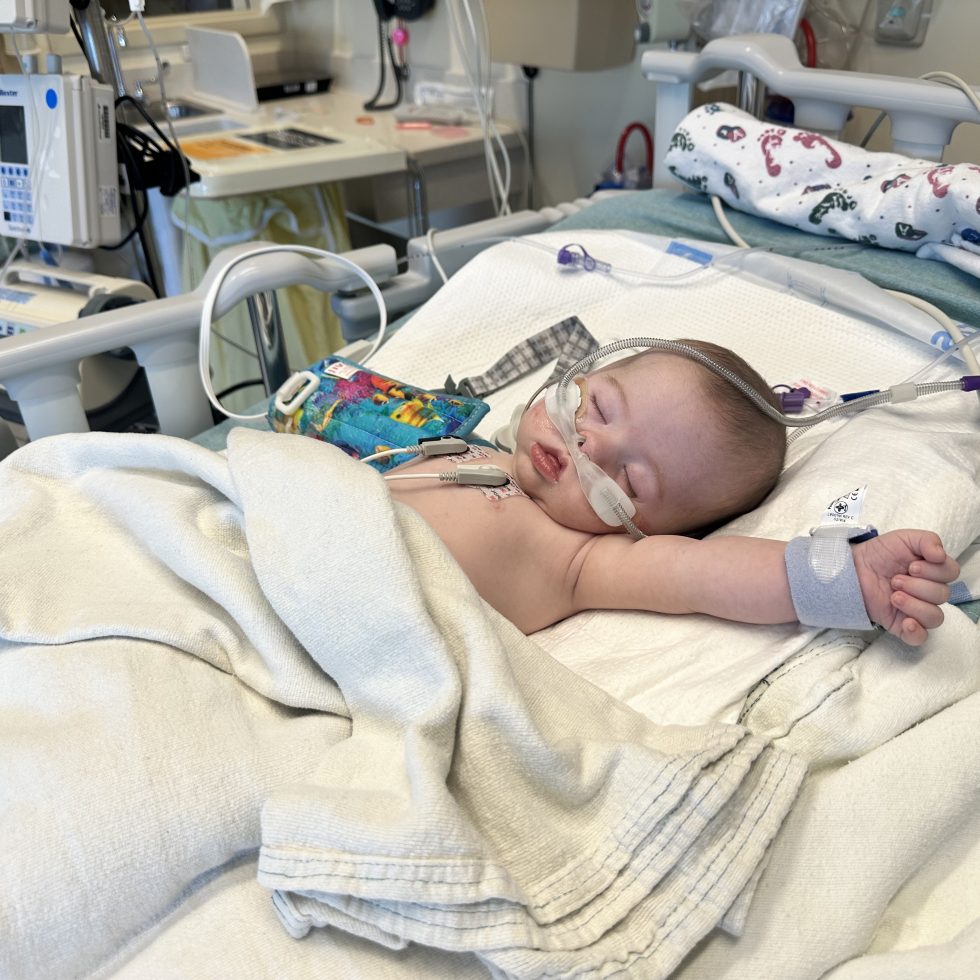
Those first few days were a “wild storm,” she says, which did not let up once Dean’s duodenal atresia was confirmed. Because soon thereafter, Victoria received the news she had been dreading: Dean had two holes in his heart, an atrial septal defect (ASD) and a ventricular septal defect.
“I don’t think there’s anything that can really prepare you for all that,” Victoria says. “[Doctors] told us this was the best heart defect kids with Down syndrome could have. It was the best of the worst.”
Kate the Great
After over a month in the Intensive Care Nursery (ICN) at the Children’s Hospital at Dartmouth (CHaD), with Dean going home on oxygen, Victoria and Christopher met Kate Richards, APRN, a pediatric nurse practitioner with CHaD’s high-risk clinic. Kate had already met Dean, as she had been checking in on him on nights during his time in the ICN when his parents couldn’t be there.
“She just knows Dean,” Victoria emphasizes. “Not in a checklist way where she’d say, ‘Kids with Down syndrome have oxygen problems.’ She’d say, ‘I think Dean is having this problem.’ And she’s been spot on every time.”
Well after his initial discharge, Dean was admitted to the PICU three times with respiratory illnesses between January and March of 2025. As if by magic, Kate would materialize in the middle of the night, on weekends, and during holidays. Eventually, Victoria and Christopher learned to recognize the “sound of her footsteps” padding down the hall.
“She’d adjust his pillow because she knew he’d breathe better that way,” Victoria says.
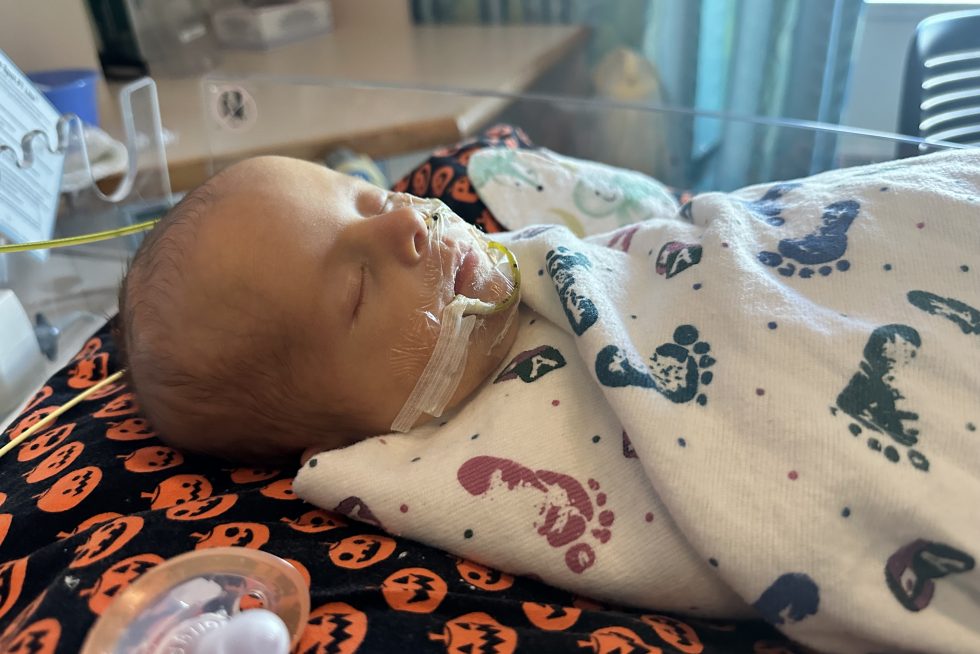
Through the terror of watching their son on tubes and monitors, seriously ill, Kate became their anchor. She’d call during lunch breaks while driving between appointments. She was there when Dean started aspirating on his feeds and needed a G-tube device inserted into his stomach. She was always going above and beyond—in ways that left Victoria speechless.
“She can be serious when she needs to be,” Victoria explains. “And then she’ll be joking around, making us feel like we wouldn’t always be [in the hospital]. That it would get better.”
For Kate, balancing medical and emotional support is an art and a science. “My job is to focus on his medical complexity, but I also try to focus on him as a kid,” she says. “His whole life isn’t just about his medical issues. And I always remember it’s exponentially harder for the family than it is for me.”
‘One in a Million’
In fall 2025, Kate advocated strongly for Dean to have surgery to repair his ASD before winter illnesses might jeopardize his condition. Close to his first birthday, Dean had cardiac surgery.
Today, against all odds, Dean is thriving. He’s off oxygen and developing skills that constantly surprise his mother. He crawls and is working on walking. He’s social, always smiling, taking in everything around him with curiosity. Kate, who will keep seeing him until at least age two, says Dean “doesn’t seem bothered by any of his limitations. He just plows right through.”
The Davies drive over an hour from Washington, N.H., for Dean’s appointments at CHaD. But “I would travel further if I needed to,” Victoria says. “Kate is one in a million.”

For families traveling similar paths, Victoria has a message: “There is light at the end of the tunnel. When they give you your baby from the NICU with follow-up care, this is the best team you can have.”
And Dean? He knows everyone in the hospital—the ICN staff, the PICU team, countless subspecialty providers. At not quite two years old, he’s built a community of caregivers who know him, love him, and celebrate every milestone.
-

Leading the Way in
‘Geriatricizing’ Health Care for AllEllen Flaherty, vice president of the Dartmouth Health Geriatric Center of Excellence, honored by The John A. Hartford Foundation with gift from longtime collaborator, friend Terry Fulmer
-
“A Real Pistol:" Gretchen Russell’s Gift to Support the Future of Cancer Research and Care
-

The Fund That
Doesn’t ForgetHow a quiet employee fund is changing lives—one hardship at a time.